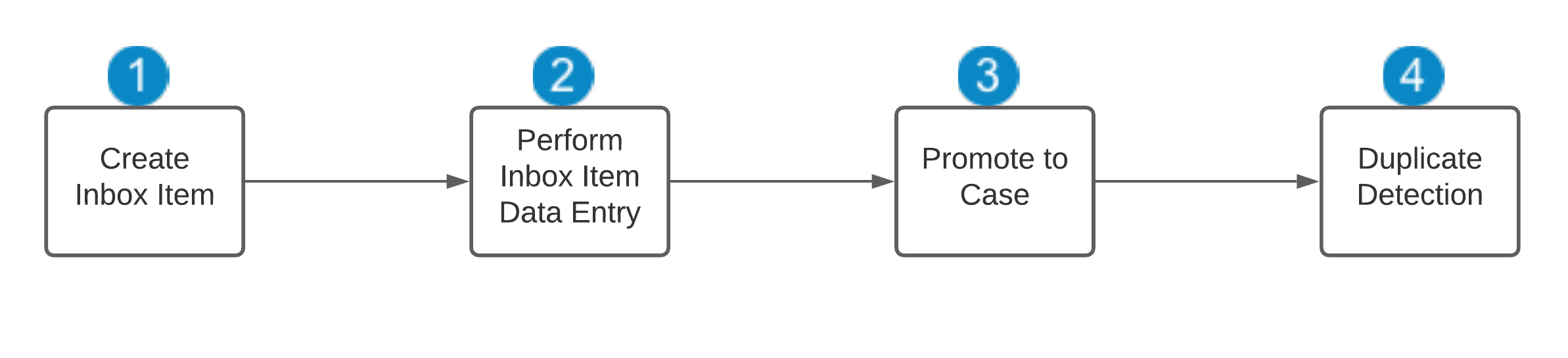
To perform case intake, create an Inbox Item to enter basic case information before promoting it to an initial or follow-up Case, or merged to an in-flight Case. You can access all Inbox Items in your Vault on the Inbox tab. The general overview of the case intake process using Inbox Items is as follows:
- Create the Inbox Item using the appropriate intake method.
- Perform Inbox Item data entry. When you promote an Inbox Item, additional data entry fields are available on the Case.
- If you’re manually creating an Inbox Item, enter the basic report information.
- If you’re generating an Inbox Item from a source file or email, review and validate the populated field values. When applicable, update Inbox Item fields as needed. For Adverse Event Report (AER) classified documents, you can use the Document Intake Highlighter to review and extract data.
- If the Inbox Item qualifies as a valid Case, promote it to a Case.
- When you promote the Inbox Item, Vault performs duplicate detection. If Vault finds matching records, complete the Potential Matches page.
Case Intake Methods
You can manually create Inbox Items and generate Inbox Items populated with field values based on the source data in the following ways:
- Imported files (including files imported using the Vault API)
- Emails and email attachments
- E2B transmissions
- Library documents
- Web Intake Forms
- Online Follow-Up Questionnaires
- Literature Articles
- Veeva Connections
Library Documents
Depending on your Admin’s configuration, Vault may automatically initiate intake by generating Inbox Items when you upload certain files to your Library:
- XML files for E2B file import
- CSV and ZIP files for multi-Case tabular data import
- Supported file formats for Adverse Event Report (AER) documents
The Inbox Item field on the source document’s Doc Info pane links to the generated record. You can navigate to the uploaded document from the Source Document field of the Inbox Item.
Adverse Event Reports
Vaults using Vault AI for Safety may automatically generate an Inbox Item for each Case > Source > Adverse Event Report (AER) classified document uploaded to your Library for the following supported file formats that meet all source file requirements:
- Electronic Mail File (EML)
- HyperText Markup Language (HTML, HTM)
- Hangul Word Processor (HWP)
- JPEG, JPG
- Microsoft Outlook Mail Messages (MSG)
- Microsoft Powerpoint Presentations (PPT, PPTX)
- Microsoft Word Documents (DOC, DOCX, DOCM, DOT, DOTM, DOTX)
- Portable Document Format (PDF)
- Portable Network Graphics (PNG)
- Rich Text Files (RTF)
- Tagged Image File Format (TIFF, TIF)
- Text (TXT, CSV)
Vault generates the Inbox Item when the uploaded document renders and populates the Inbox Item document field so you can navigate to the generated record. If your Vault does not automatically generate an Inbox Item for Adverse Event Report (AER) documents, you can initiate intake by using the Create Inbox Item from Document action or Document Intake Highlighter panel to generate the record.