SafetyDocs enables you to easily manage PSMF documents by allowing you to:
- Upload PSMF documents to your Library for use across one or more PSMF Binders
- Author, review, and approve PSMF documents
- Create global and local PSMF Binders, allowing Vault to update the Binder when any of its documents change
- Review and approve PSMF Binders
- Generate PSMF PDFs from drafted or approved PSMF Binders
- Track changes in a PSMF Logbook
Prerequisites
To use this feature, your Admin must enable:
- PSMF Automatic Logbook Generation
- PSMF Document Deletion
- Exclusion of Obsolete Documents from the PSMF PDF
- PSMF Version Binding Validation
- Order PSMF Logbook by Section/Annex
- PSMF Request Management
Upload PSMF Documents
Upload PSMF documents to your Library using one of the following dedicated PSMF document types:
- Pharmacovigilance System Master File > PSMF Binder > PSMF Global Binder
- Pharmacovigilance System Master File > PSMF Binder > PSMF Local Binder
- Pharmacovigilance System Master File > PSMF Content > PSMF Title Page
- Pharmacovigilance System Master File > PSMF Content > PSMF Core Document
- Pharmacovigilance System Master File > PSMF Content > PSMF Annex
- Pharmacovigilance System Master File > PSMF Generated Document > PSMF Table of Contents
- Pharmacovigilance System Master File > PSMF Generated Document > PSMF Logbook
- Pharmacovigilance System Master File > PSMF Generated Document > PSMF eSignature
- Pharmacovigilance System Master File > PSMF Generated Document > PSMF Generated PDF
- Pharmacovigilance System Master File > PSMF Generated Document > PSMF Generated Report
Once you have uploaded a PSMF Binder or PSMF Content document, you can include it in a periodic review to ensure its content is regularly updated.
Additional PSMF Document Functionality
Depending on your Admin’s configuration, you may be able to leverage the following functionality for PSMF documents:
- The headings you define in Word documents before uploading to your Library may influence the entries that appear in the generated table of contents. When generating a PSMF PDF from a PSMF Binder, Vault can define an entry in the table of contents for each heading in its related Word documents.
- If a PSMF Request includes a document in its PSMF Document(s) for Submission section, Vault populates the document’s PSMF Request field with that PSMF Request.
- Vault can monitor and detect when a PSMF Generated PDF document moves into the Final state and create a series of PVA obligation-related object records to allow you to take the necessary steps to address the related PSMF event.
- The value you select for the Generate Logbook Entry on Draft field determines whether Vault creates a placeholder PSMF Logbook Entry when a document is created or upversioned.
Working with PSMF Documents
You can use the following workflows to draft and finalize the necessary content updates for your PSMF Content documents:
- Author your PSMF document updates.
- Start the PSMF document review.
- Review the PSMF document.
- Approve the PSMF document.
Author a PSMF Document
To start authoring a PSMF document:
- Navigate to PSMF > PSMF Content and select the document that you want to author. Alternatively, you can navigate to a PSMF document from within a PSMF Binder.
- From the Workflow Actions menu (
 ), select Start Authoring.
 - In the Start Workflow window, enter the following information:
- Authors: Select one or more users to author the document.
- Optional: Instructions: Enter any instructions for the authors.
- Due Date: Use the calendar to select a due date or enter the date manually.
- Select Start.
Vault assigns an Author Document task to the selected authors and updates the document lifecycle state to In Authoring. To complete the assigned Author Document task:
- Navigate to the Author Document task and make the applicable document changes.
- Select Complete.
- In the Author Document dialog, select the appropriate Verdict, then select Complete.
Once complete, Vault updates the document lifecycle state to Ready for Review.
Note: Depending on your Admin’s configuration, the document may require PSMF Logbook Entries meet the following criteria before you can complete the authoring task:
- All PSMF Logbook Entries must have a Summary of Changes value.
- If the document is part of an active PSMF document workflow and is at version 1.1 or greater, the document must have a PSMF Logbook Entry from each user with an open or complete workflow task in the current active workflow associated with the document.
Add Link Annotations
During authoring, authors can add link annotations to create links to other documents within a PSMF Binder or to specific locations in a document, such as when linking content in a core document to reference data in annexes.
When manually or automatically generating an approved PSMF PDF, or when generating a draft PSMF PDF, from a PSMF Binder, Vault ignores links to Vault documents outside of the PSMF Binder and resolves only links to other documents within the PSMF Binder. This prevents non-Vault-user readers from encountering links to documents in the Vault Library that they may not have permissions to view.
Note: Link annotations that reference older versions of a PSMF document will result in an error when generating PSMF PDFs. To ensure that link annotations are automatically carried forward to new versions and always reference the latest version of a PSMF document, your Admin must:
- Enable Bring Forward Annotations on Version Create for link and anchor annotations for the relevant PSMF document classifications
- Enable linking to permalinks
Start the PSMF Document Review
To initiate the review of a PSMF document:
- For the document that you want to review, select the Workflow State Change menu (), then select Start Review.
- On the Start Workflow window, select options in the following fields:
- Reviewers
- Due Date
- Optional: Enter any instructions
- Select Start.
Vault updates the document lifecycle state to In Review and assigns a Review PSMF Document(s) task to the selected reviewers.
Review the PSMF Document
After reviewing the PSMF document, use the following steps to indicate your verdict and move the document to the next stage of the workflow:
- From within the document or on the My Tasks page, select Complete.
- On the Review PSMF Document(s) page, select from the following options:
- No changes needed, ready for approval
- Changes needed, back to draft
- Select Complete.
Result
If the verdict entered was No changes needed, ready for approval, the document lifecycle state becomes In Approval, and an Approve task is assigned to the selected approvers. If the verdict entered was Changes needed, back to draft, the document lifecycle returns to Draft so the required changes can be made.
Approve the PSMF Document
After reviewing the PSMF document, use the following steps to indicate your verdict and move the document to the next stage of the workflow:
- From within the document or on the My Tasks page, select Complete.
- On the Approve page, select from the following options:
- Approved
- Rejected, back to Draft
- Complete the fields as follows:
- In the Capacity field, select the capacity in which you are rendering a verdict.
- In the User Name and Password fields, enter your Vault login credentials to enter your eSignature.
- Select Complete.
Result
If the verdict entered was Approved, the document lifecycle state becomes Approved. In the associated PSMF Logbook, the state becomes Final and the Summary of Changes section can no longer be edited. If the verdict entered was Rejected, back to draft, the document lifecycle returns to Draft so the required changes can be made.
Working with PSMF Binders
PSMF Binders allow you to organize PSMF documents in a flexible binder structure, as well as to combine the documents into a single PDF.
Create a PSMF Binder
To create a PSMF Binder:
- Navigate to PSMF > PSMF Binders.
- Create the binder, ideally from a template1, selecting one of the following document types when prompted:
- Pharmacovigilance System Master File > PSMF Binder > PSMF Global Binder
- Pharmacovigilance System Master File > PSMF Binder > PSMF Local Binder
- Optional: Add and arrange binder content.
- Select Done Editing.
Note: 1. Depending on your Admin’s configuration, if you create a PSMF Binder from a recommended template, Vault can include a PSMF Table of Contents and a PSMF Logbook-classified document in your PSMF Binder. These placeholder documents allow Vault to generate a table of contents and logbook when generating a draft or approved PSMF PDF.
Vault creates the PSMF Binder in the Draft state.
Create a Draft of an Existing PSMF Binder
To create a draft of an existing PSMF Binder:
- From the All PSMF Binders page, select the PSMF Binder for which you want to create a draft.
- From the All Actions menu, select Create Draft.
Vault generates a draft of the selected PSMF Binder including all details except for the PSMF Table of Contents. Vault selects the latest version of each document within the binder to include in this draft.
Review and Approve PSMF Binders
Once you are ready to finalize an approved binder, you can initiate the review and approval process.
Note: If required during the binder development process, you can generate a draft PSMF PDF to conduct pre-submission reviews and quality control.
Before review and approval, Vault verifies that all PSMF Content-type documents in your PSMF Binder are bound to a state associated with the Steady or Obsolete state types, excluding automatically generated documents such as the PSMF Logbook or PSMF Table of Contents. If documents in the PSMF Binder do not meet these conditions, the PSMF Binder cannot be moved to the Approved state. This ensures that no draft documents are included in your approved PSMF PDF, and that approval is not blocked by obsolete or auto-generated documents.
Start the PSMF Binder Review
To initiate the review of a PSMF Binder:
- From the Workflow Actions menu (), select Start PSMF Review & Approval.
- In the Start Workflow window, select options in the following fields:
- PSMF Reviewer
- PSMF Approver (QPPV)
- Due Date
- Optional: Enter instructions for the reviewers and approvers.
- Select Start.
Vault updates the PSMF Binder lifecycle state to In Review, and assigns a Review PSMF Binder task to the selected reviewers. Vault selects the latest steady state version of each document within the PSMF Binder for this review.
Review the PSMF Binder
After reviewing the PSMF Binder, indicate your review verdict:
- From within the PSMF Binder or on the My Tasks page, select Complete.
- In the Review PSMF dialog, select from the following verdicts:
- Continue to approval
- Missing content, back to draft
- Select Complete.
If the verdict entered was Continue to approval, Vault updates the PSMF Binder lifecycle state to In Approval, and assigns an Approve PSMF task to the selected approvers. Vault selects the latest steady state version of each document within the PSMF Binder for this approval.
If the verdict entered was Missing content, back to draft, Vault updates the PSMF Binder lifecycle state to Draft so the required changes can be made.
Approve the PSMF Binder
After indicating a review verdict, indicate an approval verdict:
- From within the PSMF Binder or on the My Tasks page, select Complete.
- In the Approve PSMF dialog, select from the following verdicts:
- Approved
- Rejected, back to Draft
- Complete the following fields:
- Capacity: Select the capacity in which you are rendering a verdict.
- User Name and Password: Enter your Vault login credentials to enter your eSignature.
- Select Complete.
If the verdict entered was Approved, Vault updates the PSMF Binder lifecycle state to Approved. Vault generates a PDF of the full PSMF Binder contents, resolving all link annotations to other locations in the PSMF Binder as intra-document links. To access the PDF, select the Relationships icon on the Doc Info pane and expand the Generated PSMF section.
If the verdict entered was Rejected, back to draft, Vault updates the PSMF Binder lifecycle state to Draft so the required changes can be made.
PSMF Logbook
To provide a detailed record of changes made to PSMF documents, Vault includes PSMF logbook functionality:
- The PSMF Logbook document panel displays a list of PSMF Logbook Entries, or change records, for a given major version of a document
- If you add a PSMF Logbook placeholder document to a PSMF Binder, when manually or automatically generating an approved PSMF PDF for the binder, or in certain cases when generating a draft PSMF PDF for the binder, Vault aggregates all steady-state PSMF Logbooks across all of its PSMF Content documents and:
- Creates a PSMF Logbook Excel report document1 and uploads it to your Library, replacing or upversioning the placeholder PSMF Logbook document in the binder
- Uses this PSMF Logbook document to populate a logbook in the generated PDF, with each document listed using either its Name or Title value
- You can preview the PSMF Logbook for a given PSMF Binder at any time
Note: 1. Depending on your Admin’s configuration, Vault orders PSMF Logbook Entries in the PSMF Logbook document by descending date of entry or by the order of PSMF sections and annexes.
PSMF Logbook Panel
When accessing a PSMF Content document, the PSMF Logbook panel contains a list of PSMF Logbook Entries detailing changes made to that document. Whenever you create or upversion a PSMF Content document to a new major version, Vault creates a placeholder PSMF Logbook Entry1 and populates the Date of Change and Person Making Change fields.
Note: 1. If the document has a Generate Logbook Entry on Draft value of No, Vault does not create a placeholder PSMF Logbook Entry.
Depending on your permissions, you can add, edit, or delete PSMF Logbook Entries on a PSMF Content document as needed.
Navigate the PSMF Logbook Panel
Within the PSMF Logbook panel, Vault displays up to 10 PSMF Logbook Entries per page. If a document contains more than 10 entries, select the Next ( ) and Previous (
 ) icons to navigate between pages.
To search through the PSMF Logbook Entries on a document, select the search bar then enter a search term and select Search ( ) icon, or select Enter on your keyboard. Vault returns all PSMF Logbook Entries that contain the exact specified term in the Person Making Change or Summary of Changes fields.
Add a PSMF Logbook Entry
To manually add a PSMF Logbook Entry to a PSMF Content document:
- Navigate to the PSMF Content document.
- From the Doc Info pane, select the PSMF Logbook (
 ) icon to open the PSMF Logbook panel.
 - Select the Add Logbook Entry (+) icon.
- Complete the applicable fields, then select Save.
Note: You cannot add PSMF Logbook Entries to documents in the Approved state.
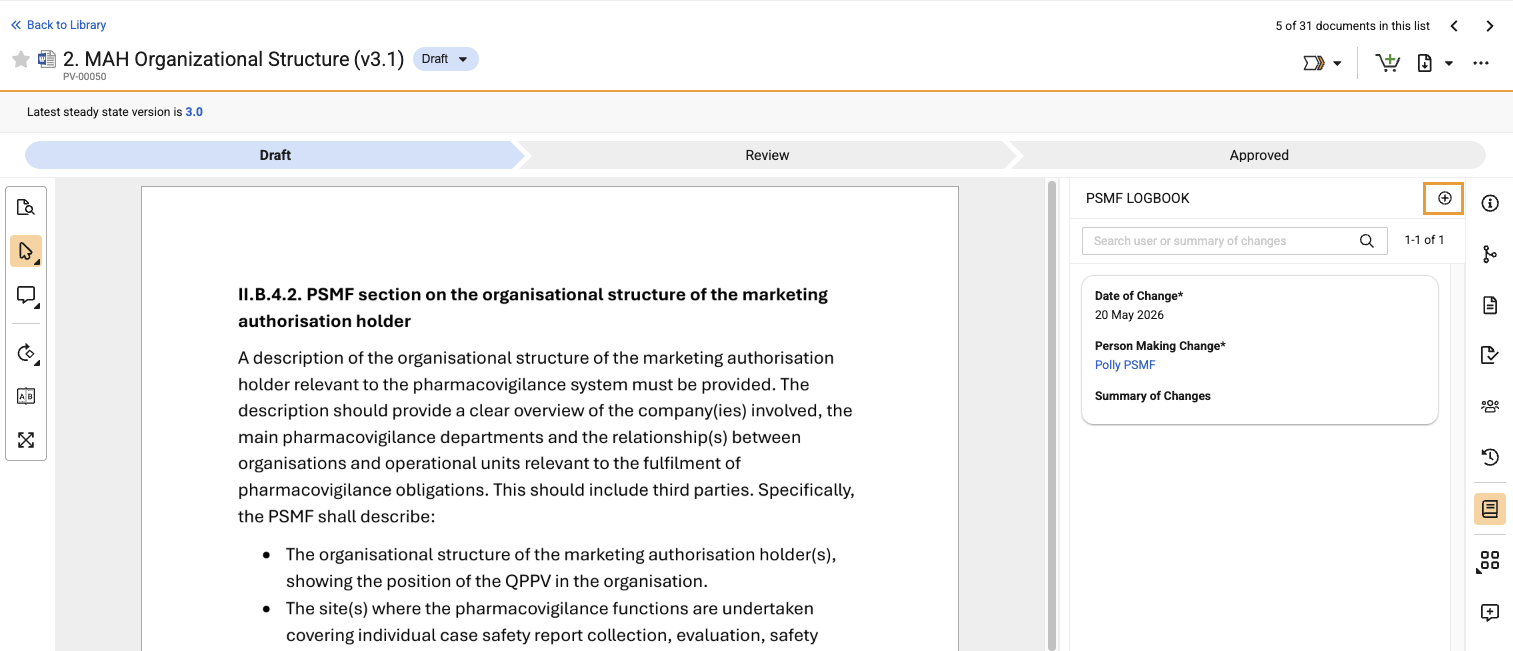
PSMF Logbook Entry Fields
The following fields may be available:
| Field | Description |
|---|---|
| Date of Change | When Vault creates a PSMF Logbook Entry, this field defaults to the current date. To change it, use the calendar to select the date or enter the date manually. |
| Person Making Change | When Vault creates a PSMF Logbook Entry, this field defaults to the document Owner. When manually creating a PSMF Logbook Entry, Vault populates the current user. To change it, select a user from the picklist or select the Advanced Search icon to use filters and refine your search. |
| Summary of Changes | When Vault creates a PSMF Logbook Entry, this field is left blank. Enter a description of the changes made to the document. |
Edit and Delete PSMF Logbook Entries
Depending on your permissions, you can edit and delete PSMF Logbook Entries on a PSMF Content document:
- To edit a PSMF Logbook Entry, select the Edit (
 ) icon.
 - To delete a PSMF Logbook Entry, select the Delete (
 ) icon. To retain an audit trail, you cannot delete a PSMF Logbook Entry if it is the only PSMF Logbook Entry for the document version.
Depending on your Admin’s configuration, you may be able to edit or delete only PSMF Logbook Entries for which you are the user referenced in the Person Making Change field. If you have the standard PSMF Office role, you may be able to edit any PSMF Logbook Entries.
Note: When you delete a PSMF Content document, Vault also deletes the corresponding PSMF Logbook and any associated PSMF Logbook Entries.
Preview the PSMF Logbook
To preview the PSMF Logbook for a PSMF Binder:
- On the Analytics tab, select Reports.
- Select the relevant PSMF Binder Logbook report.
- In the Binder > Binder Name field, select the PSMF Binder you want to preview, and then select Continue.
PSMF Table of Contents
Depending on your Admin’s configuration, when generating a PSMF Binder, Vault can create and merge a table of contents into any draft or approved PSMF PDFs generated from the PSMF Binder. To generate a PSMF Table of Contents document, your PSMF Binder must include a document with the PSMF Table of Contents classification created from your Admin’s table of contents template.
When generating the table of contents, Vault:
- Generates an entry for each:
- Section in the PSMF Binder
- Document in the PSMF Binder, listed using either the document’s Name or Title value
- Document heading within each Microsoft Word document, up to the specified heading level defined by your Admin, indented to reflect the heading nesting1
- Links each document or heading entry to the first page of the document or the specific heading location
- Creates a new major version of the PSMF Table of Contents document and sets it to a steady state
Note: 1. When a document contains headings that are not nested sequentially, Vault indents the entries in the table of contents as if they are sequential, regardless of the headings defined in the original Word document. For example, if a document begins with a Heading 2 and its next heading is a Heading 5, Vault indents the Heading 2 as if it is a top-level heading (Heading 1), then indents the Heading 5 beneath that as if it is a second-level heading (Heading 2).
eSignature Page
If the PSMF Binder includes a document with the PSMF eSignature classification and an eSignature has been manifested for the current lifecycle state of the PSMF Binder, Vault uses it to generate an eSignature page leveraging your Admin’s eSignature template. This page is included in the generated approved PSMF PDF.
When generating a draft PSMF PDF that includes PSMF Annex documents, Vault includes the eSignature page from the most recently approved PSMF Binder.
Note: Each binder can have only one document of the type Pharmacovigilance System Master File > PSMF Generated Document > PSMF eSignature.
Generate a Draft PSMF PDF
If required, you can generate a draft PSMF PDF from a PSMF Binder in any non-steady state, allowing you to conduct pre-submission reviews, internal QC checks, and compare versions as needed during the authoring process.
To manually generate a draft PSMF PDF from a PSMF Binder:
- Create a new PSMF Binder or create a draft of an existing PSMF Binder.
- From the All Actions menu, select
 Generate Draft PSMF PDF.
 - In the Generate Draft PSMF PDF dialog, clear the Exclude Annexes checkbox as required, then select Continue.
- Optional: To download the PSMF PDF:
- Navigate to PSMF > Generated PSMFs.
- Select the relevant PSMF Generated PDF.
- Download the document as a source file or a PDF.
Vault generates a PSMF PDF as follows:
- The PDF includes a PSMF Table of Contents and an eSignature page
- The PDF includes the latest version of each document bound to the binder1, regardless of state, except for:
- Documents in an obsolete state type
- Placeholder documents
- Documents without a viewable rendition
- If you selected Exclude Annexes, Vault additionally excludes:
- PSMF Annex documents
- PSMF Generated Report documents
- PSMF Logbook documents
- All link annotations to other locations in the PSMF Binder are resolved as intra-document links within the generated PDF
- All pages are numbered in continuous Arabic numerals
Vault additionally upversions the most recent existing PSMF Generated PDF document to a new minor version. If a draft PSMF PDF cannot be generated, Vault sends a notification with details on how to address any errors.
Note: 1. We recommend running the Generate Draft PSMF PDF action on only working draft binders. If you run the Generate Draft PSMF PDF action after having already approved the PSMF Binder, Vault may exclude updated documents from the table of contents and generated PDF.
Generate an Approved PSMF PDF
To manually generate a PSMF PDF from an approved PSMF Binder:
- Create a new PSMF Binder or create a draft of an existing PSMF Binder.
- Review and approve the PSMF Binder, ensuring that each document is in a steady state.
- Select Generate PSMF PDF.
- Optional: To download the PSMF PDF:
- Navigate to PSMF > Generated PSMFs.
- Select the relevant PSMF Generated PDF.
- Download the document as a source file or a PDF.
Vault generates a PSMF PDF as follows:
- The PDF includes:
- A PSMF Table of Contents
- The latest steady state version of each document bound to the binder
- The PSMF Logbooks associated with these documents, with each document listed using either its Name or Title value
- An eSignature page
- All link annotations to other locations in the PSMF Binder are resolved as intra-document links within the generated PDF
- All pages are numbered in continuous Arabic numerals
If Vault cannot generate a PSMF PDF, Vault sends a notification with details on how to address any errors.